GHOST BALL METHOD
The GHOST BALL METHOD (GBM) is most commonly used when explaining to beginners how to aim properly. This method is indeed mostly targeting the beginner and intermediate levels of players. Advanced and Pro-Players will use the GBM especially on Carom Shots, because if you rely on feel, you will almost always hit carom shots too thick. Nevertheless, the GBM is one of the most important aiming methods.
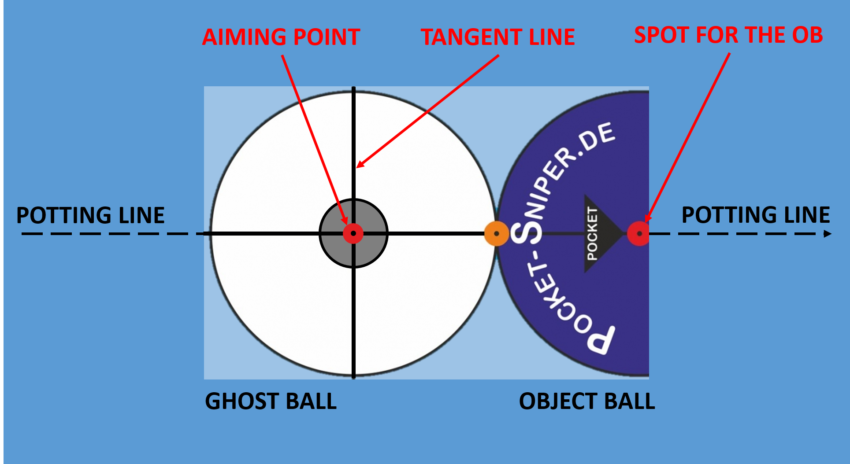
The GBM requires that the player imagines the Cue Ball position at the point of impact, when the Cue Ball is frozen on the Object Ball, touching it at the point of contact, and than to aim at the center of this imaginary Ghost Ball. Sounds quite simple, but for most players it is very difficult to imagine this Ghost Ball and to see the Aiming Point. And that is exactly where POCKET-SNIPER comes into the game!
Place the Object Ball at the intended spot and you are basically ready to fire away! It is necessary to shoot the Cue Ball directly through the center (Aiming Point) of the white circle (Ghost Ball) to succeed. The other black line, at a 90° angle with the center line, represents the Tangent Line and the path the Cue Ball will take when a cut shot is played as a stun-shot (no forward or rearward rotation of the Cue Ball at the time of contact with the Object Ball). Now deliver the Cue Ball with a straight stroke to the Aiming Point and you will make the Object Ball into the pocket.
Example 3
Now if you come behind the Cue Ball, align yourself to the Aiming Point. This imaginary line from the Cue Ball to the Aiming Point is your Stroke Line. Get down into your stance, swing your cue a few times to make sure you are perfectly aligned to the Aiming Point. When you are ready, stop with the swing of your cue and focus. This is your point of no return. You are confident, there are no doubts any more. Swing slowly back with your cue and deliver the stroke towards the Aiming Point through the Cue Ball and stay down. Watch the Object Ball fall into the pocket. Now stand up and continue your drill.
Example 4